From tower to screen: How digital towers are changing the ATC landscape
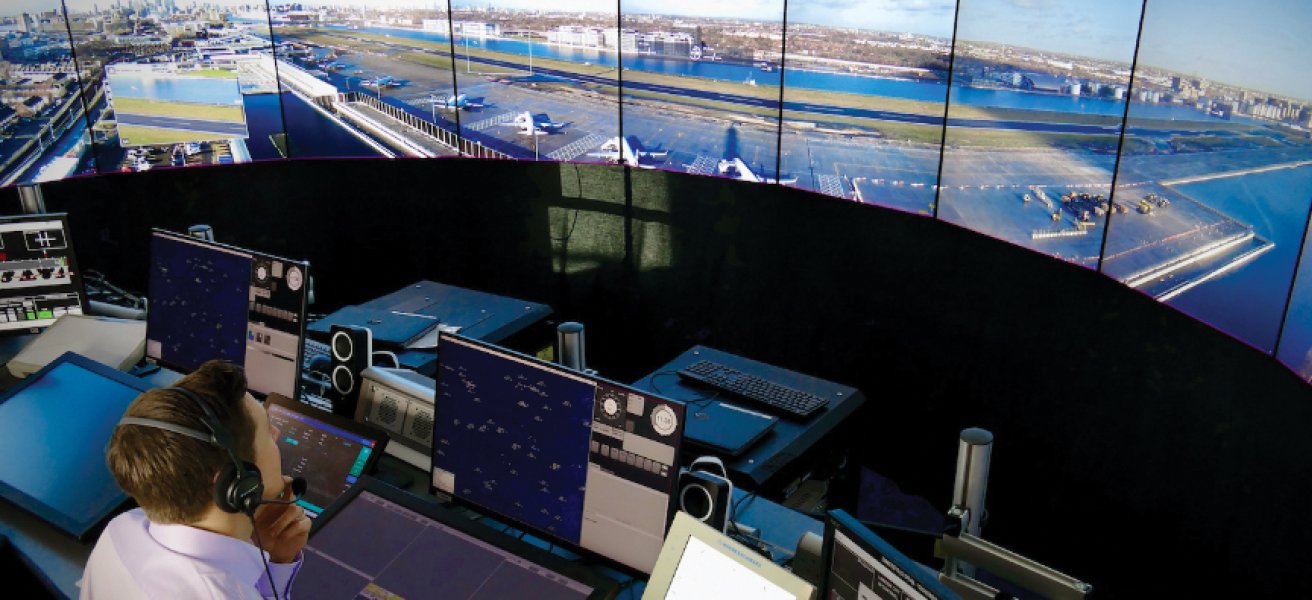
For many, the control tower is a fixture of the airport skyline. The tall, glass-topped structure that houses controllers who watch runways with their own eyes. Today, that picture is changing fast. Across Europe, and increasingly beyond, Air Traffic Control (ATC) is moving into centralized rooms filled with screens, fed by cameras and sensors instead of windows. This is the digital, or "remote", tower and nowhere is this shift more advanced than in Norway.
Norway’s digital towers, at a glance
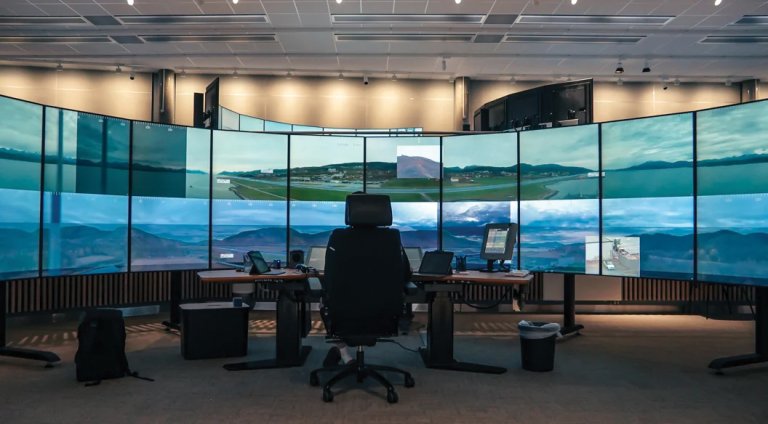
In May 2022, Avinor opened its Digital Towers Centre in Bodø – now the world's largest facility of its kind. As of today, 14 airports are operated from the centre. In February 2024, Avinor's board decided to transfer six additional towers to Bodø, and the new Mo i Rana airport is also planned to be digitally operated from the same centre. Once complete, this will bring the number of towers managed from Bodø to 21. These are Aerodrome Flight Information Service (AFIS) towers serving short-runway airports, of which there are many in Norway.
The purpose, according to Avinor, is straightforward: many of Norway's control towers are due for renovation or replacement, and digital towers help avoid that cost while allowing a single controller to eventually manage traffic at multiple airports from one working position – improving efficiency and helping sustain route networks at smaller airports.
Why Norway is ahead of the curve
Norway is a geographically elongated country with a large number of small airports that each see relatively little daily traffic. Historically, that has meant staffing towers with a handful of people spread across the entire country.
According to Øivind Ramde, Director of Business Development for Ricochet, Norway’s geography is an essential part of understanding why we’re seeing a large presence of digital towers in the Scandinavian country. The same can be said for neighbouring Sweden, a similarly geographically elongated country, which has rolled out digital towers across several airports. Digital towers, connected into a shared network like the one in Bodø, make ATC dramatically more efficient.
And what about the rest of Europe?
Digital towers show up elsewhere in the ATC Network bulletin's 2023 overview of the sector:
- Germany's DFS has been operating a remote tower centre in Leipzig for several years, now covering multiple regional airports.
- Estonia's EANS launched its own remote tower system, REVAL, at Kuressaare.
- Romania's ROMATSA chose a remote virtual tower solution for its newly built Brasov airport.
- The UK’s NATS has been operating the country’s first digital tower solution at London City Airport since 2021.
- Italy's ENAV inaugurated the country's first digital tower in Brindisi.
Ramde points to Canada as a natural comparison for where this could go next – a country with similarly vast geography and dispersed airports, facing many of the same infrastructure questions Norway has already worked through.
The US is trailing behind – but why?
The contrast is sharpest, however, when looking at the United States. As aviation policy commentator Robert W. Poole Jr. pointed out in a piece included in the same ATC Network bulletin, the FAA's plan to replace 30 smaller control towers by 2030 makes no mention of remote or digital towers at all – despite the technology being certified and operational in half a dozen European countries.
Ramde confirms this gap still exists: the FAA has not approved remote/digital towers for public use in the US, even though they accept submissions of digital tower designs for review. Where digital towers do exist in America today, they tend to be private installations run by individual companies rather than nationally sanctioned infrastructure. Why the FAA has been slower to adopt the technology remains unclear, according to Ramde.
Read also: Jotron records North Atlantic air traffic

What is a digital tower, exactly?
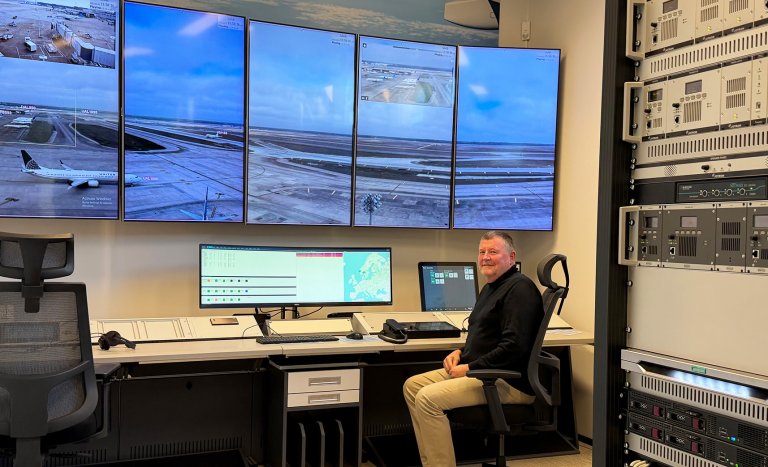
Stripped down, a digital tower replaces the physical, elevated structure with cameras, microphones, and other sensors installed around the airport, feeding a bank of screens at a control position – whether that position sits at the airport itself or, as in Bodø, hundreds of kilometers away.
Behind every digital tower is a video wall, and every screen must be recorded, synchronised, and available for later replay and review. This is where Jotron's Ricochet system comes in.
Meeting the challenge: Making it all replayable and verifiable
A typical digital tower video wall might consist of anywhere from 7 to 16 vertical HD monitors, three to five horizontal 4K monitors, or up to ten vertical 4K monitors for a full 360-degree view. Alongside the video wall, controller working position (CWP) screens – flight data displays, VCS panels, ASMGCS, radar – also need to be captured.
Ricochet handles all of these inputs and can integrate the recordings with a facility's standard ATM/ATC audio recorder, so that video wall footage, CWP screens, and voice communications (including approach and ground-ground channels) can all be replayed in sync.
Regional differences
What needs to be covered varies enormously by region and airport, according to Ramde. In the US, cameras are typically focused on a mast pointed at the terminal area – the zone operators actually care about. In Norway, the requirement is different: full 360-degree coverage of the entire airport, which means far more screens and much higher resolution. At Orly in France, warehouses around the airfield create blind spots that require additional camera angles to eliminate.
The system is built to adapt to whatever configuration a given digital tower provider uses. Development is also ongoing on dual-row image layouts, to support even more complex visual setups going forward.
Read also: Comprehensive system upgrade at Orly International Airport
Ricochet’s solution – what sets us apart
Recording individual screens is one thing; making that footage usable afterwards is another. According to Ramde, Ricochet was among the first recording systems on the market to offer video wall stitching, taking the feed, for example from 14 separate monitors and combining them into a single, continuous wide image. That stitched image can then be replayed on just one or two screens, with free panning and zooming across the full width of the original video wall, rather than requiring a full replica video wall just to review a recording.
Depending on the provider's video wall setup, Ricochet supports several recording approaches – from hardware video grabbers placed in line between the graphics controller and the monitor, to daisy-chained or parallel/duplicated signal capture, to receiving video streams directly from a provider's own software grabber (or Ricochet's own).
The system is built to scale with resolution too: standard hardware grabbers handle up to 20 frames per second on HD monitors, with more advanced grabbers and Ricochet's software grabber supporting multiple 4K screens simultaneously at the same frame rate.
Read also: Why we developed the Ricochet Investigator
Data at scale
As digital towers add more cameras, higher resolutions, and more screens, the underlying recording challenge only grows. Storage requirements for a single day's footage can range from 20-50 GB per HD monitor to 50-100 GB per 4K monitor, depending on frame rate – multiplied across every screen in every tower.
Ramde also flags a different kind of challenge emerging in other parts of the world: in several Latin American countries, the cameras and infrastructure that Europe and North America take for granted simply aren't in place yet. Similar infrastructure challenges exist across many countries in Asia and Africa. In addition, where multiple parallel systems exist, moving and storing that volume of data in and out reliably becomes a significant hurdle in its own right – arguably a bigger constraint than the recording technology itself.
Why this matters
Norway's digital tower programme – anchored by the world's largest facility in Bodø – is a clear signal of where air traffic control is heading. But as more airports move traffic control off-site and onto screens, the ability to record, synchronise, and replay everything that happens on those screens becomes just as critical as the live operation itself. It's not just a technical detail; it's the layer that ensures this transformation remains safe, accountable, and verifiable at every step.
References
- ATC Network: Remote and Digital Towers: Special Bulletin Series 2023
- Avinor: Digital towers